Pakistan Stock Exchange Sectors Explained: A Beginner’s Guide to PSX Industries & Sector List
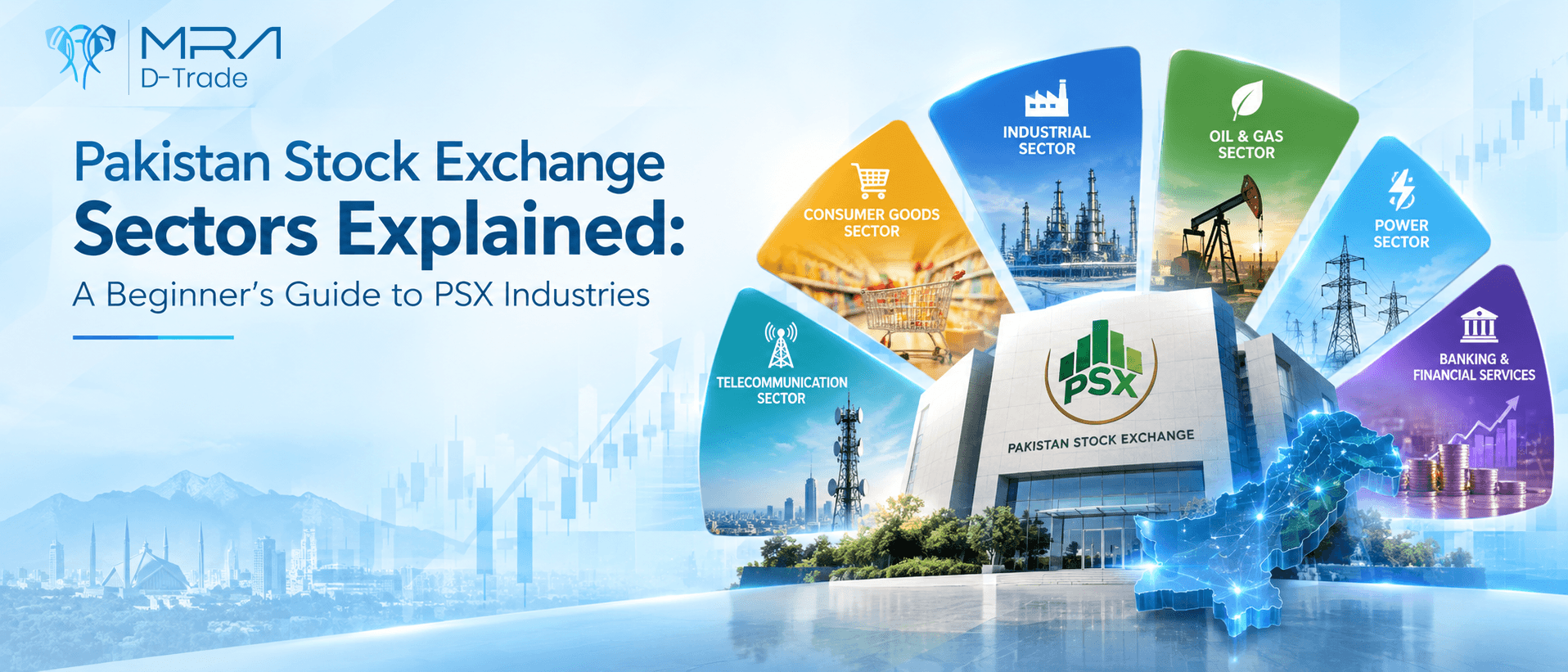
The Pakistan Stock Exchange (PSX) is not just a collection of random companies. It is organized into well-defined Pakistan Stock Exchange sectors that group listed businesses by their core economic activity. For beginners, understanding the sectors of Pakistan Stock Exchange is one of the fastest ways to turn confusing ticker symbols into a clear, logical view of the market.
This guide explains the PSX sector list, how industries are classified, what drives the most important PSX industries, and how you can use sector analysis to improve your investment decisions.
What Are Pakistan Stock Exchange Sectors?
A sector is a group of companies that operate in the same or closely related industries. For example, all listed commercial banks fall under the banking sector, while all cement producers fall under the cement sector.
The Pakistan Stock Exchange industry classification helps investors:
- Compare companies with similar business models.
- Identify which parts of the economy are growing or slowing.
- Track sector-specific risks, such as oil prices or interest rates.
- Build diversified portfolios instead of concentrating in one industry.
When market analysts at MRA Securities talk about the stock market, they often start with sector performance before analyzing individual PSX listed companies. That is because sector trends can often matter more than a single company’s news.
PSX Sector List: A Snapshot
The PSX sector list includes more than 30 industries. While the exact number can change as companies list or delist, the major sectors of Pakistan Stock Exchange include:
- Commercial Banks
- Oil & Gas Exploration Companies
- Oil & Gas Marketing Companies
- Cement
- Fertilizer
- Power Generation & Distribution
- Automobile Assembler
- Automobile Parts & Accessories
- Pharmaceuticals
- Technology & Communication
- Textile Composite
- Textile Spinning
- Textile Weaving
- Food & Personal Care Products
- Chemical
- Engineering
- Insurance
- Refinery
- Tobacco
- Glass & Ceramics
- Paper & Board
- Transport
- Miscellaneous
These PSX industries vary greatly in size, liquidity, and economic sensitivity. Some sectors dominate the KSE-100 index, while others play a smaller role in overall market capitalization.
Key PSX Industries and What Drives Them
To understand the Pakistan Stock Market sectors, it helps to look at the largest and most actively traded industries.
1. Commercial Banks
Banking is usually the heavyweight of the PSX. Banks such as HBL, UBL, and MCB are among the most liquid PSX listed companies. This sector is highly sensitive to:
- Interest rate changes by the State Bank of Pakistan.
- Deposit growth and loan demand.
- Asset quality and non-performing loans.
- Government borrowing patterns.
When interest rates rise, bank margins often improve, making banking a key sector for macro-focused investors.
2. Oil & Gas Exploration and Marketing
This sector includes exploration companies that find and produce oil and gas, as well as marketing companies that distribute petroleum products. Key drivers include:
- International crude oil prices.
- Local gas pricing policies.
- Production volumes from major fields.
- Circular debt issues in the energy chain.
Oil and gas stocks can offer attractive dividends but carry commodity price risk.
3. Cement
Cement is one of the most closely watched PSX sectors because it reflects construction activity and infrastructure spending. Cement companies like Lucky Cement, DG Khan Cement, and Maple Leaf Cement are influenced by:
- Domestic construction demand and housing schemes.
- Government development spending, especially PSDP projects.
- Coal and electricity costs.
- Interest rates, which affect property financing.
A booming construction cycle usually benefits the entire cement sector.
4. Fertilizer
Fertilizer is a major pillar of Pakistan’s agricultural economy. Companies like Engro Fertilizers, Fauji Fertilizer, and Fatima Fertilizer dominate this space. Key factors include:
- Gas availability and pricing for feedstock.
- Urea and DAP demand from farmers.
- Government subsidy and support policies.
- Global fertilizer prices.
Fertilizer stocks are often known for strong dividends and stable earnings when gas supply is reliable.
5. Power Generation & Distribution
Power companies such as Hub Power and K-Electric operate in this essential sector. Investors watch:
- Capacity payments and tariff adjustments.
- Circular debt resolution.
- Fuel prices, especially for thermal plants.
- Demand for electricity from industrial and residential users.
Regulatory clarity from NEPRA and government energy policy heavily influence this sector.
6. Automobile Assembler and Parts
Pakistan’s auto sector includes assemblers like Indus Motor, Honda Atlas, and Suzuki, along with dozens of parts manufacturers. The sector is driven by:
- Exchange rate movements, because many parts are imported.
- Auto financing rates.
- Consumer purchasing power.
- Import duties and government auto policy.
When the rupee weakens or rates rise, auto demand tends to slow.
7. Textile Composite, Spinning, and Weaving
Textile is one of the largest employers and export earners in Pakistan. The PSX classifies textile companies into composite, spinning, and weaving sub-sectors. Performance depends on:
- Cotton prices and crop quality.
- Energy costs, especially gas and electricity.
- Export demand from the US, Europe, and China.
- Currency movement, which affects export competitiveness.
Textile stocks can be volatile but offer exposure to Pakistan’s core export industry.
8. Pharmaceuticals
Pharmaceutical companies like Searle, GlaxoSmithKline Pakistan, and Abbott Pakistan operate in a defensive sector. Demand for medicines is relatively stable, but the sector faces:
- Drug pricing regulations from DRAP.
- Import restrictions on raw materials.
- Competition from local and multinational players.
- Healthcare spending trends.
A stable regulatory environment can make pharmaceuticals an attractive defensive play.
9. Technology & Communication
This is one of the faster-growing PSX industries, including software houses, IT exporters, and telecom-related firms. Companies like Systems Limited and TRG Pakistan draw attention from growth-focused investors. Key drivers include:
- Growth in IT exports and freelancing services.
- Global demand for software and business process outsourcing.
- Local telecom and broadband penetration.
- Regulatory support from PSEB and government IT policies.
Technology stocks can be more volatile but offer long-term growth potential.
10. Food & Personal Care
This sector includes consumer staples like Nestle Pakistan, Unilever Pakistan, and Colgate-Palmolive. These companies sell everyday products such as food, beverages, and hygiene items. The sector benefits from:
- Population growth and urbanization.
- Brand loyalty and pricing power.
- Input costs like edible oil, milk, and packaging.
- Consumer spending power and inflation.
Because demand is steady, food and personal care stocks are often considered defensive.
Defensive vs. Cyclical Sectors in PSX
One of the most useful concepts for beginners is the difference between defensive and cyclical sectors.
Defensive sectors tend to perform relatively well even during economic downturns because people still need their products. Examples in Pakistan include:
- Pharmaceuticals
- Food & Personal Care
- Power Generation
- Tobacco
Cyclical sectors rise and fall with the economy. They often do well during expansion but struggle during slowdowns. Examples include:
- Cement
- Automobiles
- Textiles
- Engineering
- Chemicals
Understanding this split helps you balance your portfolio according to your risk tolerance and the economic outlook.
How Beginners Can Use PSX Sector Analysis
If you are new to investing in Pakistan Stock Exchange, do not try to track every company at once. Start with sectors.
Here is a simple framework:
1. Check the macro picture: Are interest rates going up or down? Is the rupee stable or volatile? Is government spending rising?
2. Identify beneficiary sectors: For example, falling interest rates may benefit autos and cement. Rising rates may support banks.
3. Compare peers within the sector: Once you identify an attractive sector, compare its companies using earnings, dividends, and valuation.
4. Diversify across sectors: Avoid putting all your money into one sector, even if it looks strong.
5. Follow sector-specific news: Oil prices, gas tariffs, crop outlooks, and regulatory changes matter more than general market noise.
At MRA Securities Limited, our research team regularly publishes sector reports and market commentary to help investors navigate Pakistan Stock Exchange sectors with clarity.
Final Thoughts
Learning the Pakistan Stock Exchange sectors is an essential step for any beginner. The PSX sector list is more than just labels—it is a map of Pakistan’s economy. From banking’s link to interest rates to cement’s dependence on construction demand, every sector tells a story about where money is flowing and where risks are building.
By understanding the different types of sectors in PSX, you can make better decisions, avoid herd mentality, and build a portfolio that aligns with your financial goals. Whether you prefer defensive pharma stocks or cyclical cement plays, sector knowledge gives you the foundation to invest with confidence.
---
Frequently Asked Questions
1. How many sectors are there in the Pakistan Stock Exchange?
The Pakistan Stock Exchange classifies listed companies into more than 30 sectors. The exact number can vary slightly as companies list, merge, or delist. Major sectors include commercial banks, oil and gas, cement, fertilizer, power, textiles, pharmaceuticals, technology, and food and personal care.
2. Which PSX sectors are best for defensive investors?
Defensive investors typically favor sectors with stable demand regardless of economic conditions. In the PSX, pharmaceuticals, food and personal care, power generation, and tobacco are often considered defensive because people continue to use these products and services even during downturns. However, no sector is completely risk-free, so diversification is still important.
3. How can I start investing in PSX sectors through MRA Securities?
To start investing in the Pakistan Stock Exchange, you can open a brokerage account with MRA Securities Limited. Once your account is active, you can invest in individual stocks from different PSX sectors, build a diversified portfolio, and access research reports that explain sector trends, valuations, and market outlooks.