Free Float in Pakistan Stock Market: Meaning, Calculation & Importance Explained
Free Float in Pakistan Stock Market: Meaning, Calculation & Importance Explained
When investors look at a company listed on the Pakistan Stock Exchange (PSX), they often focus on share price, earnings, and total market capitalization. However, one of the most important stock market fundamentals—especially for liquidity and index performance—is free float. Understanding free float meaning can help you make better investment decisions in Pakistan’s equity market.
In this Pakistan Stock Market Guide, we explain what is free float, how free float calculation works, and why free float in PSX matters for traders, long-term investors, and index trackers.
What Is Free Float?
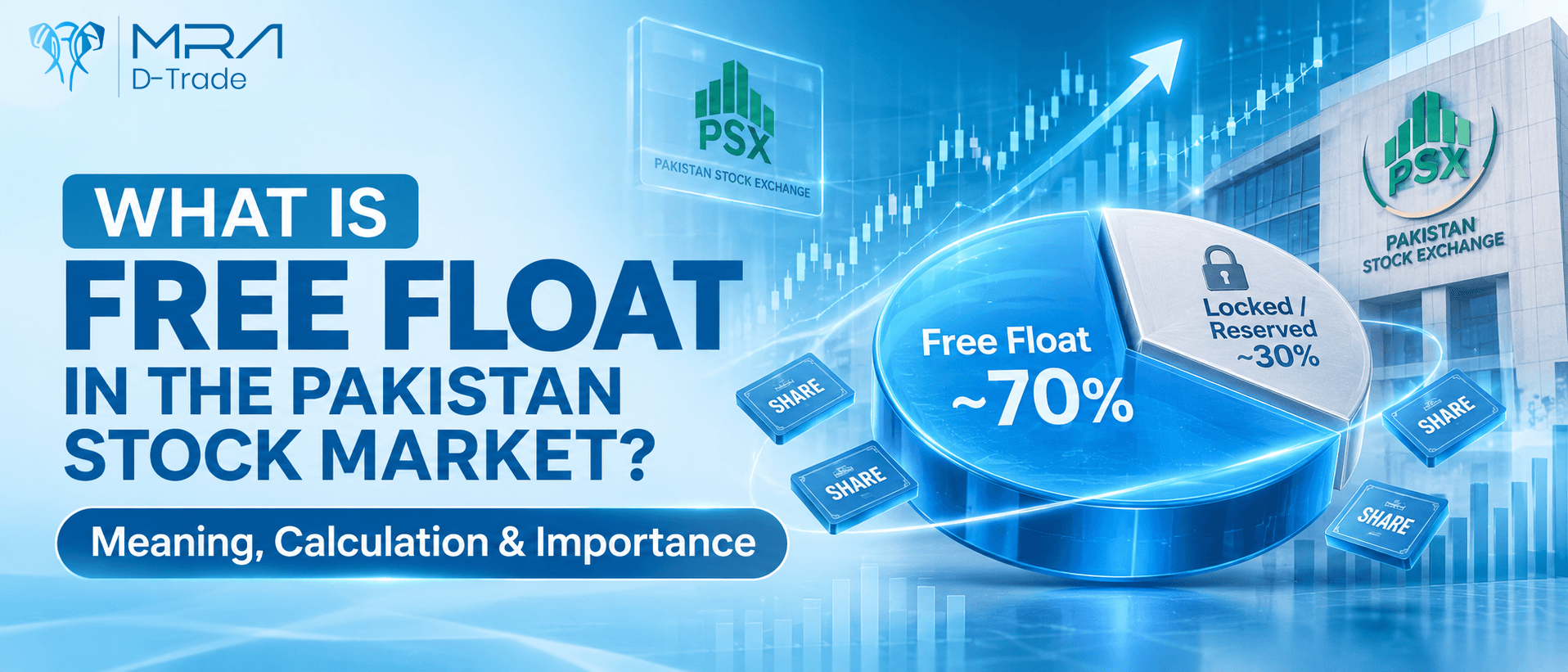
Free float, also known as public float, refers to the number of shares of a listed company that are actually available for trading in the open market. These are the shares that can be freely bought and sold by ordinary investors on the stock exchange.
Free float shares exclude shares that are held by:
- Sponsors, promoters, and directors
- Government bodies or state-owned entities
- Strategic investors and associated companies
- Employees or trusts with locked-in restrictions
- Any other shares that are not readily tradable
In simple terms, free float represents the truly liquid portion of a company’s share capital. The rest of the shares may exist on paper, but they are not part of daily trading activity.
Free Float Meaning in the Context of the Pakistan Stock Exchange
In the Pakistan Stock Exchange, many listed companies have concentrated ownership. Family-owned businesses, government-controlled enterprises, and companies with large strategic investors often have a significant portion of shares that rarely change hands. As a result, the number of shares available for trading—the free float—can be much lower than the total outstanding shares.
For example, a company may have 100 million total shares, but if the founding family holds 60 million and the government holds 10 million, only 30 million shares are freely available for public trading. That means the free float percentage is only 30%.
PSX free float is particularly important because it gives a realistic picture of how many shares can actually be traded without causing major price disruption. It is also a key input for calculating free float adjusted market capitalization, which is used by PSX indices.
How to Calculate Free Float
Free float calculation is straightforward. The basic formula is:
Free Float Shares = Total Outstanding Shares – Restricted Shares
Restricted shares include promoter holdings, government stakes, locked-in shares, and other strategic holdings that are not available for trading.
To express free float as a percentage:
Free Float Percentage = (Free Float Shares ÷ Total Outstanding Shares) × 100
Once you know the free float shares, you can calculate free float market capitalization:
Free Float Market Capitalization = Current Market Price × Free Float Shares
Example of Free Float Calculation
Suppose ABC Limited is listed on the Pakistan Stock Exchange and has 200 million total outstanding shares. The shareholding structure is as follows:
- Sponsors and directors: 90 million shares
- Government holding: 20 million shares
- Locked-in shares: 10 million shares
- General public and institutions: 80 million shares
Here, the restricted shares total 120 million (90 + 20 + 10). Therefore:
Free float shares = 200 million – 120 million = 80 million shares
Free float percentage = (80 million ÷ 200 million) × 100 = 40%
If ABC Limited’s share price is Rs 50, then:
Total market capitalization = 200 million × Rs 50 = Rs 10 billion
Free float market capitalization = 80 million × Rs 50 = Rs 4 billion
This difference is significant, especially when a stock is considered for index inclusion.
Importance of Free Float in the Pakistan Stock Market
Free float is not just an academic concept. It has real implications for liquidity, price discovery, volatility, and index performance.
1. Stock Market Liquidity
Stocks with a high free float generally have better stock market liquidity. More shares available for trading means buyers and sellers can execute orders more easily without causing large price swings. On the PSX, high free float stocks often record higher PSX trading volume and tighter bid-ask spreads.
2. Price Discovery
When a large number of shares are freely traded, the stock price reflects the collective judgment of many market participants. Low free float stocks, by contrast, may be dominated by a few large holders, making price discovery less reliable.
3. Volatility
Low free float stocks tend to be more volatile. A relatively small buy or sell order can move the price sharply because there are fewer shares available to absorb the trade. This can create both opportunities and risks for traders.
4. Index Weighting
PSX indices such as the KSE-100, KSE-30, and KMI-30 use free float adjusted market capitalization to determine a stock’s weight in the index. A company with a large total market cap but a low free float may have a smaller index weight than a company with a smaller total market cap but a higher free float. This ensures that the index reflects shares that are actually investable.
5. Foreign and Institutional Investment
Foreign investors, mutual funds, and pension funds prefer stocks with sufficient free float. They need to enter and exit positions without moving the market significantly. A healthy free float percentage is often a precondition for institutional investment in listed companies in Pakistan.
6. Corporate Governance Signal
While not a perfect measure, a higher free float often indicates a broader shareholder base and can be a positive signal for corporate governance. Companies with extremely low free float may face additional scrutiny from investors concerned about minority shareholder rights.
Free Float vs Total Market Capitalization
Many new investors confuse total market capitalization with free float market capitalization. The difference matters:
- Total Market Capitalization = Share price × Total outstanding shares
- Free Float Market Capitalization = Share price × Free float shares
Total market capitalization tells you the overall size of a company. Free float market capitalization tells you how much of that value is actually available for public trading. For index calculation and liquidity analysis, free float market capitalization is the more practical measure.
Free Float in PSX Indices
The Pakistan Stock Exchange has adopted free float methodology for its main indices. This means that when the KSE-100 index is calculated, each company’s weight is based on its free float market capitalization, not its total market capitalization. The same applies to other indices like the KSE-30 and KMI-30.
This approach prevents a few companies with large market caps but very low public float from distorting the index. It also makes the indices more representative of the shares that investors can actually buy and sell.
How Investors Can Use Free Float
Understanding free float can improve your investment analysis in several ways:
- Screen for liquidity: Before investing, check the free float percentage. A very low free float may mean you will struggle to exit your position during volatile markets.
- Assess price impact: If you plan to buy a large number of shares, low free float stocks may be difficult to accumulate without pushing the price up.
- Evaluate index changes: When a stock is added to or removed from a PSX index, its free float adjusted market capitalization is a key factor. Tracking free float changes can help you anticipate index rebalancing flows.
- Understand supply and demand: Low free float stocks can rally sharply on positive news because supply is limited. However, the reverse is also true during sell-offs.
Limitations of Free Float
While free float is a valuable metric, it is not static. Shareholders can sell or transfer shares, companies can issue new shares, or lock-in periods can expire—all of which change the free float. Investors should review free float data regularly and combine it with other stock market fundamentals such as earnings, valuation, and sector trends.
Conclusion
Free float in the Pakistan Stock Market is a critical concept that every investor should understand. It measures the shares available for trading, influences stock market liquidity, affects price volatility, and determines how companies are weighted in PSX indices. By learning free float meaning, mastering free float calculation, and paying attention to free float percentage, you can make more informed decisions and better navigate the Pakistan Stock Exchange.
Whether you are a beginner building a portfolio or an experienced trader analyzing PSX trading volume, free float should be part of your stock market investment basics. A stock with healthy free float is generally more liquid, more transparent, and more attractive to institutional and foreign investors—making it an important factor in long-term investment success.
---
Frequently Asked Questions (FAQs)
1. What is the difference between free float and total outstanding shares?
Total outstanding shares include every share issued by a company, including those held by promoters, directors, governments, and strategic investors. Free float shares are only the portion of outstanding shares that are freely available for trading in the open market. For example, if a company has 100 million outstanding shares and 60 million are held by sponsors, the free float is 40 million shares.
2. How does free float affect a stock’s inclusion in the KSE-100 index?
The KSE-100 index uses free float adjusted market capitalization to determine a stock’s weight. A company with a high total market cap but low free float may have a smaller index weight than a company with a lower total market cap but higher free float. This ensures the index reflects shares that are actually available for investors to trade.
3. Why do some PSX-listed companies have very low free float?
Many companies listed on the Pakistan Stock Exchange have concentrated ownership structures. Founding families, government entities, or strategic investors often hold large blocks of shares that are not actively traded. As a result, the free float percentage can be low, sometimes below 20%, which reduces liquidity and increases price volatility.